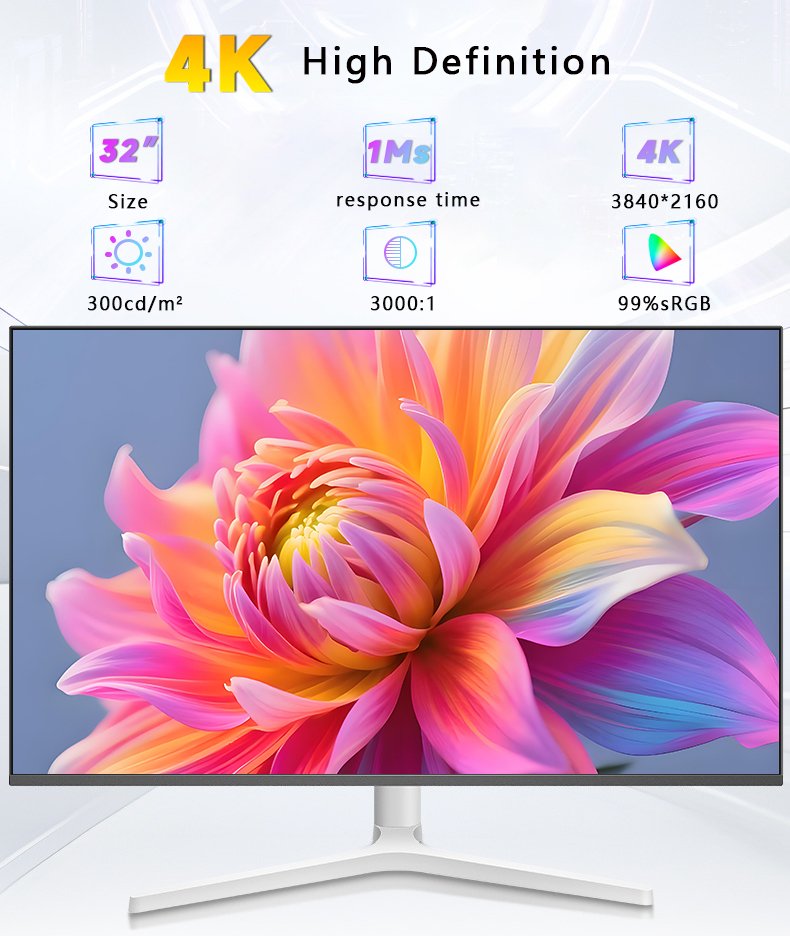
In recent years, the European monitor market has witnessed a significant surge in the popularity of 4K LCD monitors. This transition from Full HD to ultra-high definition is not a random trend but is driven by a powerful confluence of demand-side shifts, supply-side advancements, and evolving user applications.
Primary Market Drivers in Europe
The European market’s embrace of 4K is fueled by several distinct factors:
- The Esports and High-Performance Gaming Boom: Europe is a core region for competitive gaming, where display performance is paramount. Major esports leagues designated 4K/144 Hz monitors as the tournament standard in 2024, creating a powerful “halo effect” for consumer models. European enthusiasts seek monitors that offer not only stunning clarity for immersive game worlds but also the high refresh rates necessary for competitive play. This has made 4K high-refresh-rate gaming monitors one of the fastest-growing segments.
- Proliferation of 4K Content and Hybrid Work: The rapid adoption of 4K streaming services has been a key driver. Over 60% of new content from major streaming platforms was offered in 4K in 2024, compelling households to upgrade their compatible screens. Furthermore, the shift towards hybrid and remote work has increased demand for monitors that enhance productivity. A 4K monitor provides substantially more screen real estate than lower-resolution displays, facilitating efficient multitasking, detailed graphic design, and precise video editing.
- Improving Price-to-Performance Ratio: The increasing affordability of 4K LCD monitors is a fundamental catalyst. Government subsidies and capacity expansions in panel manufacturing hubs, particularly in Asia, have driven down production costs. Additionally, the integration of technologies like Mini-LED backlighting has enhanced the performance of LCD monitors—offering better contrast and brightness—at increasingly competitive price points, making 4K resolution accessible to a broader mid-range market.
Technological Evolution Enabling the Shift
The rise of 4K LCD monitors is underpinned by continuous technological progress across the display industry.
- Panel Technology Competition: While LCD monitors maintain a dominant market share due to their cost-effectiveness and mature supply chains, new technologies are pushing the entire market forward. The rapid development and adoption of OLED and QD-OLED monitor panels, exemplified by LG Display’s recent announcement of a 27-inch 4K 240Hz OLED panel, are setting new benchmarks for image quality, response time, and refresh rates. This competition incentivizes innovation across all monitor types, including LCD monitors.
- Performance Beyond Resolution: The modern 4K monitor is defined by more than just pixel count. Features like high dynamic range (HDR) for better contrast, wide color gamuts (like DCI-P3) for accurate colors, and adaptive sync technologies (like FreeSync and G-Sync) for smooth gameplay have become standard expectations. The integration of these features into LCD monitors has significantly enhanced their value proposition.
- Supply Chain and Manufacturing Scale: The established, global manufacturing infrastructure for LCD monitor panels allows for efficient large-scale production. This scale enables manufacturers to offer a wide variety of 4K monitors in different sizes (with 20-25 inches and 25+ inches being key segments), panel technologies (IPS for color accuracy, VA for contrast), and feature sets to meet diverse European consumer needs


Challenges and the Road Ahead
Despite strong growth, the European 4K monitor market faces specific challenges. Proposed EU Ecodesign regulations focusing on energy efficiency and repairability for larger displays may increase compliance costs for monitor manufacturers. Furthermore, occasional supply chain constraints, such as the 2024-25 shortage of HDMI 2.1 chipsets, can temporarily impact the availability of high-end models.
In conclusion, the ascendance of 4K LCD monitors in Europe is a multifaceted story. It is driven by strong local demand from gamers and professionals, fueled by the widespread availability of 4K content, and made possible by a favorable price trajectory due to global manufacturing scale and technological cross-pollination. As panel technologies continue to evolve and prices gradually decline, 4K resolution is poised to solidify its position as the new mainstream standard for computer monitors across the European continent.